

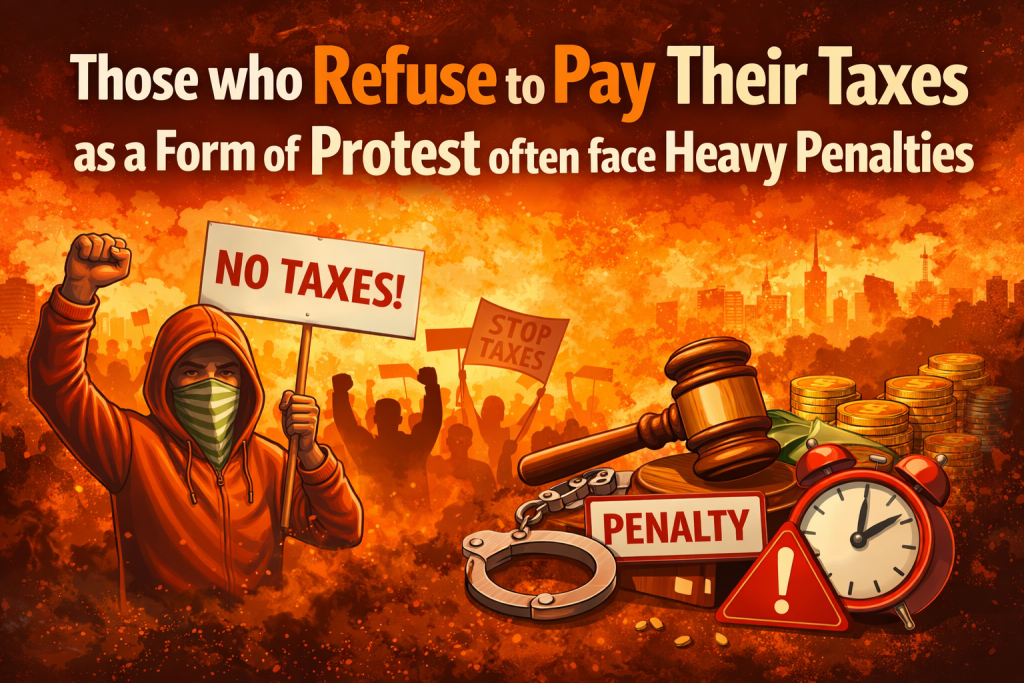
Across the world, tax resistance has historically been used as a form of civil protest. From disagreements with government policies to dissatisfaction with public services, some citizens adopt “tax refusal” as a way to voice displeasure.
In Nigeria, however, this path has serious legal consequences—especially under the Nigeria Tax Administration Act (NTAA) 2025, which significantly strengthens enforcement, compliance obligations, and penalties for default.
This article explores the phenomenon of tax refusal in today’s climate and highlights what the law says about non‑compliance.
Why Some People Refuse to Pay Taxes
Tax refusal typically arises from:
- Perceived over‑taxation
- Distrust in government’s use of public funds
- Protests against specific policies or reforms
- Economic hardship
- Reaction to new tax laws or stricter compliance enforcement
While these grievances may feel justified, choosing not to pay taxes is not recognized under Nigerian law as a form of legal protest. Taxes are a statutory obligation, and the NTAA 2025 ensures that government revenue is protected.
What the Nigeria Tax Administration Act 2025 Says About Non‑Compliance
The NTAA 2025 overhauled Nigeria’s tax administration to increase revenue, improve compliance, and reduce leakages. It introduced clearer timelines, stronger enforcement powers, and significantly heavier sanctions.
Here are the key implications for anyone who refuses to pay taxes as a form of protest:
1. Mandatory Registration & Filing Requirements
Under Sections of the NTAA 2025:
- Individuals and companies must register for tax,
- File annual tax returns, and
- Pay assessed taxes when due.
Failure to do so is automatically treated as non‑compliance, regardless of the reason—including protest.
2. Penalties for Non‑Payment of Taxes
The Act imposes strict penalties on taxpayers who delay or refuse tax payment, including:
a. Monetary Penalties
Depending on the type of tax:
- Daily accumulating penalties for late payment
- Interest on outstanding amounts
- Additional administrative charges
These penalties continue until full settlement.
b. Assessment by Tax Authorities
If a taxpayer refuses to file or pay:
- The authority may issue a Best of Judgment (BOJ) assessment.
- This assessment becomes final unless challenged within the statutory time frame.
Once finalized, refusal to pay becomes a prosecutable offence.
3. Criminal Penalties
NTAA 2025 introduces stronger criminal sanctions for willful non‑compliance, including:
- Fines
- Seizure of assets
- Closure of business premises
- Prosecution that may lead to imprisonment in extreme cases
Tax refusal as protest can therefore escalate into a criminal investigation.
4. Powers of Enforcement
The Act empowers tax authorities to:
- Appoint banks as collection agents
- Freeze taxpayer accounts to recover unpaid taxes
- Distrain property (i.e., seize and sell assets)
- Restrict certain business activities until compliance is achieved
These steps may be taken without prior court approval in certain instances, making enforcement swift and difficult to evade.
5. Impact on Businesses and Individuals
Refusing to pay taxes can result in:
- Blacklisting from government procurement
- Inability to obtain tax clearance certificates (TCC)
- Withholding of business licenses or permits
- Additional penalties that exceed original tax liabilities
- Reputational damage and regulatory scrutiny
For individuals, it also affects:
- Loan applications
- Visa processing requiring tax records
- Employment in regulated industries
In essence, tax refusal creates far more problems than it solves.
Peaceful Protest vs. Non‑Compliance: Know the Difference
While Nigerians have the constitutional right to protest, the law does not allow withholding taxes as a legitimate form of protest. The NTAA 2025 views tax refusal strictly as non‑compliance, with consequences that continue to accumulate until resolved.
Those dissatisfied with tax policy may instead:
- Engage through civil society groups
- Petition legislators
- Participate in public hearings on tax bills
- Use lawful advocacy channels
But refusing to pay taxes is not a legally protected protest method in Nigeria.
Conclusion
Tax resistance may appear symbolic or harmless, but under the Nigeria Tax Administration Act 2025, it triggers heavy fines, interest, enforcement actions, and even criminal liability.
The cost of non‑compliance is simply too high.
At JTAX.ng, our focus is to help Nigerians understand their obligations clearly and avoid unnecessary penalties—while also encouraging peaceful, lawful channels for civic expression.
Disclaimer
This article is for information and educational purposes only. It does not constitute financial, tax, or legal advice. For personalized guidance, please consult a qualified tax professional or legal adviser.

Leave a Reply